AsyncEndpoint
AsyncEndpoint Examples
Examples of using the AsyncEndpoint class are listed at the bottom of this page Examples.
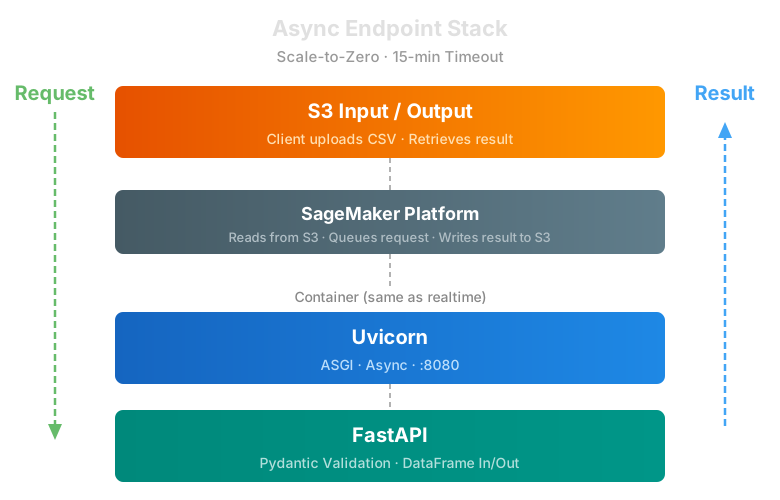
AsyncEndpoint is a drop-in replacement for Endpoint that supports long-running inference (up to 15 minutes per invocation). It scales to zero when idle so you only pay for compute during active batch runs. The API is the same as Endpoint: send a DataFrame, get a DataFrame back. The async S3 round-trip is handled internally — callers don't see it.
AsyncEndpoint: Workbench API wrapper for async SageMaker endpoints.
Drop-in replacement for Endpoint that uses the async invocation
path internally. The caller-facing API is identical — inference()
returns a DataFrame synchronously.
Example
AsyncEndpoint
Bases: AsyncEndpointCore
Workbench AsyncEndpoint API class.
Inherits all functionality from AsyncEndpointCore. This thin wrapper exists to match the Endpoint / EndpointCore pattern used elsewhere in the Workbench API layer.
Source code in src/workbench/api/async_endpoint.py
fast_inference(eval_df, threads=4)
Run inference on the Endpoint (async path, threads ignored).
Parameters:
| Name | Type | Description | Default |
|---|---|---|---|
eval_df
|
DataFrame
|
The DataFrame to run predictions on |
required |
threads
|
int
|
Ignored for async endpoints (kept for API compat) |
4
|
Returns:
| Type | Description |
|---|---|
DataFrame
|
pd.DataFrame: The DataFrame with predictions |
Source code in src/workbench/api/async_endpoint.py
inference(eval_df, capture_name=None, id_column=None, drop_error_rows=False, include_quantiles=False)
Run inference on the Endpoint using the provided DataFrame.
Parameters:
| Name | Type | Description | Default |
|---|---|---|---|
eval_df
|
DataFrame
|
The DataFrame to run predictions on |
required |
capture_name
|
str
|
Name of the inference capture (default: None) |
None
|
id_column
|
str
|
Name of the ID column (default: None) |
None
|
drop_error_rows
|
bool
|
Whether to drop rows with errors (default: False) |
False
|
include_quantiles
|
bool
|
Include q_* quantile columns (default: False) |
False
|
Returns:
| Type | Description |
|---|---|
DataFrame
|
pd.DataFrame: The DataFrame with inference results |
Source code in src/workbench/api/async_endpoint.py
Examples
Run Inference on an Async Endpoint
from workbench.api import AsyncEndpoint
# Grab an existing Async Endpoint
endpoint = AsyncEndpoint("smiles-to-3d-boltzmann-v1")
# Run inference — same API as Endpoint, async S3 polling is handled internally
results_df = endpoint.inference(df)
Use with InferenceCache for Batch Processing
from workbench.api import AsyncEndpoint
from workbench.api.inference_cache import InferenceCache
# Wrap in InferenceCache for persistent S3-backed caching
endpoint = AsyncEndpoint("smiles-to-3d-boltzmann-v1")
cached_endpoint = InferenceCache(endpoint, cache_key_column="smiles")
# Only uncached rows are sent to the endpoint
results_df = cached_endpoint.inference(big_df)
Deploy an Async Endpoint from a Model
from workbench.api import Model
model = Model("smiles-to-3d-boltzmann-v1")
end = model.to_endpoint(
async_endpoint=True,
instance="ml.c7i.2xlarge",
tags=["smiles", "3d descriptors", "boltzmann"],
)
Async endpoints deploy with scale-to-zero auto-scaling -- the instance spins down after ~10 minutes of idle time and cold-starts on the next request. This makes them cost-effective for overnight batch workloads.
When to Use AsyncEndpoint vs Endpoint
| Endpoint | AsyncEndpoint | |
|---|---|---|
| Invocation timeout | 60 seconds | 15 minutes |
| Scaling | Fixed instance count | Scale-to-zero when idle |
| Best for | Realtime inference, low latency | Long-running batch processing |
| Cost when idle | Pays for running instance | Zero (scales down) |
Not Finding a particular method?
The Workbench API Classes use the 'Core' Classes Internally, so for an extensive listing of all the methods available please take a deep dive into: Workbench Core Classes